Has GPT-6-Astra Achieved Embodied Intelligence?

Embodied competence — largely yes.
Practical embodied intelligence — not yet.

We ask not only how capable GPT-6-Astra is, but what its capabilities imply for the field: we probe its limits on 12 benchmarks, dissect the harness behind it, validate it on eight real-robot platforms, and prototype what the next generation of embodied benchmarks should measure.

01 · Empirical Study

Large-Scale Study under a Unified Protocol

Probing the capability upper bound of GPT-6-Astra across 12 benchmarks

GPT-6-Astra under a protocol that allows in-context learning on the training set and extends the execution budget up to 10×. Published baselines are reported under the standard budget, collected as of October 12, 2026. *Result with a VLA model. ‡Zero-shot, without access to training data.

In-context learning protocol

Training data demonstrations, or exploration in training scenes test episodes excluded study ICL preparation GPT-6 inspects the data, keeps what it judges useful, writes notes and code model weights fixed freeze K knowledge package hashed, read-only copy Test episode GPT-6 Environment fresh session; step limit 1× or 10× actions observations nothing written back; no transfer between episodes
ICL

In-context learning from the training set

Successful demonstrations are conventionally accessible when training smaller task-specific policies, so GPT-6-Astra may use them too. It studies the training data and builds a frozen knowledge package of task guidance, motion and visual references, executable helpers, recovery procedures and metadata, then retrieves and adapts these resources to each test scene.

10×

A substantially larger execution budget

We allow up to 10× the official step limit, since standard step limits can significantly underestimate GPT-6-Astra. Its emerging capability for failure recovery lets it translate additional steps into higher success, nearly saturating SIMPLE and the LIBERO family. Extensions continue the same episode — no resets.

In-context learning: what GPT-6-Astra keeps

Contents of an ICL knowledge package

Knowledge package Kwritten by GPT-6-Astra during ICL preparation · frozen before testing
Test episode
GPT-6
retrieve · adapt · check
observations
+ robot states

Success rate versus step budget

Success rate versus step budget. The budget is expressed as a multiple of each benchmark's official step limit; dots show observed success rates and pink curves show fitted trends. We evaluate budgets up to 10× the official limit (1× for BEHAVIOR). The gray line marks the upper bound, which assumes that every episode that exhausts the evaluated budget without succeeding has the potential to succeed with an unlimited budget.

Limitations and failure modes

1 / 5
Limitation

ICL packages are largely task-specific, which limits transfer

Packages are built from each benchmark's training data, so their benefit weakens once test tasks move away from it. Packages that generalize beyond their source tasks remain an open direction.

RoboDojo · Open group
Lowest SR

No task-specific demonstrations; it relies on a package studied from the other four groups. GPT-6-Astra + ICL still benefits from more interaction, but attains the lowest success of all groups.

RoboLab · no training set
69.2%

No task-level package can be built (zero-shot, 10× budget). GPT-6-Astra leads the best listed baseline (42.9%), yet its absolute success remains moderate.

Close coverage
>95%

Where test tasks follow the training distribution — LIBERO family, SIMPLE, VLN-CE — demonstrated motions or routes are retrieved almost directly and success approaches saturation: above 95% on the LIBERO family and SIMPLE, around 90% on VLN-CE at 10×.

SIMPLE · zero-shot → ICL
70.8 → 90.8%

Standard-budget success on the four common tasks, with shorter successful episodes under ICL.

Limitation

Time and cost remain high

Even nearly solved benchmarks are expensive: about 1M tokens and nearly an hour per LIBERO-Long++ episode, roughly 9M tokens and nearly two hours on LIBERO-Ultra-Long. Extending the budget adds more, concentrated in difficult episodes that often still fail: on RoboDojo, an extended-budget episode takes more than three hours on average.

About 98% of tokens are cached input, so 1M tokens ≈ 1 USD. Inference latency is not counted in the step budget, so this cost also limits deployment where real-time control is required.

Average per-task cost by benchmark

Tokens (M)

Time (min)

Failure mode

Verifying physical success

GPT-6-Astra can tell a task is unfinished but not which physical condition is unmet, so its corrections fail to converge. Looking done, or reporting done, is not the same as meeting the task's contact, support and alignment conditions.

Failure mode

Recovering from consequential actions

Each attempt changes the state that recovery starts from, and some changes cannot be undone. A failed prerequisite blocks every later subtask while retries drain the budget.

Recovery works when GPT-6-Astra changes strategy rather than repeating itself, as in DexJoCo Fold Glasses, where a side approach and a test lift complete the task.

Failure mode

Preserving progress over long horizons

Earlier progress must stay intact while later actions run, yet a later motion can undo it, and small errors in grasping, placement or navigation compound across stages. GPT-6-Astra has to keep rechecking what it has already done rather than treating completed subgoals as permanently resolved.

02 · Harness Ablation

Harness Matters: An Ablation

Token cost versus success rate on RoboDojo

42 RoboDojo tasks; performance is the unweighted mean of category success rate. Dashed lines cross at the Agentic GPT-6-Astra baseline; upper-left is better on both axes. Standalone VLA (π0.5, 6.91%) uses no GPT tokens and is not plotted. Hover a point to compare it with the baseline.
A · System 1 – System 2 collaboration

Supervision pays off, but every review costs tokens

Letting the VLA run alone is insufficient; GPT-6-Astra reviewing its proposed actions works, but costs tokens. Reviewing four at a time saves 63.5% of tokens over per-action review, and adding ICL gives the best result — at about 6.9× the tokens of the best closed-loop setting without ICL.

5.83%open-loop25.83%closed-loop · L = 454.17%ICL + VLA
B · Action representation & chunking

Interfaces should match how the model reasons

Directional commands help and joint angles hurt. Letting the model choose its chunk size beats a fixed chunk in success rate, at a higher token cost.

+2.50directional−5.84joint-angle+4.44adaptive chunk
03 · Real-World Validation

What Still Separates Benchmark Success from Deployment

01 / ZERO-SHOT

No demonstrations, no knowledge package

GPT-6-Astra performs as a generalist, without task- or robot-specific training.

02 / HUMAN PRIORS

Structured context written by a human

Tool schemas, joint limits, camera placement, safety constraints, hand presets and, on some platforms, task-level guidance such as admissible grasp points — no high-level semantic skills such as pick, place or insert.

03 / WALL CLOCK

Budgeted in time, judged by a person

Trials are normally limited to 60 minutes. An operator holds an emergency stop, and success is judged from the physical outcome, not the model's own claim.

Embodiment#Main questionTasks
Single arm
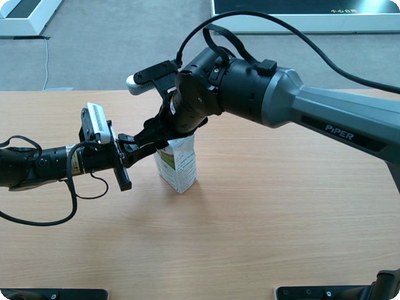
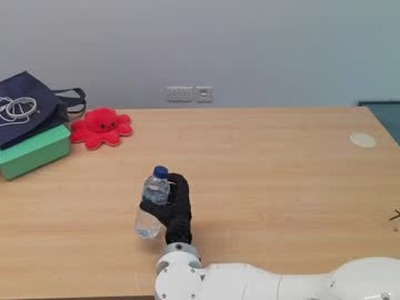
Single arm, gripperFranka 3, Franka Panda, PiPER + Pika gripper
3Do simulation results transfer, from rigid to deformable and precise tasks?
  • Stacking and container nesting
  • Cloth and towel folding
  • Plug insertion
Dual arm
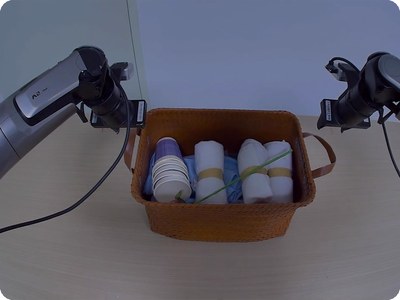
Dual arm, grippersAgileX Piper
1Can GPT-6-Astra coordinate two arms on harder zero-shot tasks?
  • Ordered folding
  • Flower insertion
  • Bimanual holding
  • Sorting
Dexterous hands
Dual arm, dexterous handsTianji M6S
1Can GPT-6-Astra control high-DoF hands?
  • Toy and bottle grasping
Wheeled mobile manipulator
Wheeled mobile manipulatorGalaxea R1 Pro, AgileX Tracer + xArm7
2Can GPT-6-Astra act over room-scale distances and long horizons?
  • Find washer and press button
  • Flower collection
  • Tray arrangement
  • Navigation and search
Humanoid
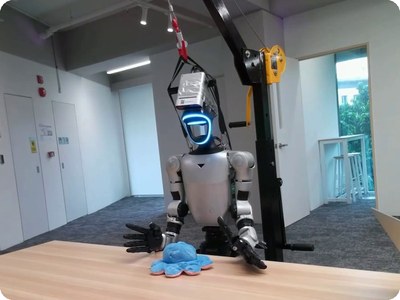
HumanoidUnitree G1
1Can GPT-6-Astra act as System 2 over low-level locomotion and arm control?
  • Tabletop pick-and-drop
  • Turn, approach and stop

Findings and what changes in the real world

1 / 4
Finding 1

One model drives every embodiment; success depends on the task

Without platform-specific training, the same model controls all eight platforms. Rigid pick-and-place is reliable and matches simulation, whereas deformable objects, precise contact and long-horizon mobile tasks remain markedly harder. A second arm extends the range of zero-shot tasks, and GPT-6-Astra re-plans from execution feedback when the scene changes.

17/18
Rigid pick-and-placestacking, nesting, toy grasps
2/4
Deformable objectscloth folding on the Franka 3
9/23
Long-horizon mobilenavigation & search, AgileX Tracer
0/11
Precise contactplug insertion, three platforms
Finding 2

What GPT-6-Astra can do depends on what it can see

In flower insertion, the gripper holds the stem vertically, so its own wrist camera cannot see the vase mouth. On a single arm the insertion fails. On the dual-arm Piper, GPT-6-Astra moves the free arm until its wrist camera sees the vase mouth, then completes the insertion — the viewpoint becomes part of the action space. Teleoperated demonstrations rarely contain this active vision.

Finding 3

GPT-6-Astra as System 2 over existing System 0 motor control

On a real Unitree G1 with Wuji hands, GPT-6-Astra commands arm-joint targets and binary hand states for manipulation (2/3), and turns and walks through the vendor velocity interface (3/3) — without a task-trained System 1 policy. This establishes feasibility under slow, feedback-driven supervision rather than reliable real-time visuomotor control.

What changes

What changes in the real world

In simulation, extra steps and failed attempts cost nothing, and demonstrations of the test task exist. On real robots neither holds: physical constraints limit extended execution, and missing demonstrations reshape in-context learning.

Physical constraints

Extended execution is not free on real hardware

Extra steps and retries cost nothing in simulation. On real robots, protective stops and hardware faults end runs, and elapsed time adds tokens, risk, hardware stress and supervision.

2 / 3PiPER plug-insertion trials ended by a joint collision fault62 °Chand temperature guard~90 %of G1 time deliberating
Missing demonstrations

Context quality decides the outcome

Human-written context can stand in for demonstrations, but it is expert prompt engineering. Building context from other sources is an open problem.

0 / 3Tianji grasps without grasp primitives3 / 3with human-written primitives5context sources untested
04 · Prototype

Towards a Next-Generation Embodied Benchmark

01 / HUMAN NEEDS

Tasks derived from human needs

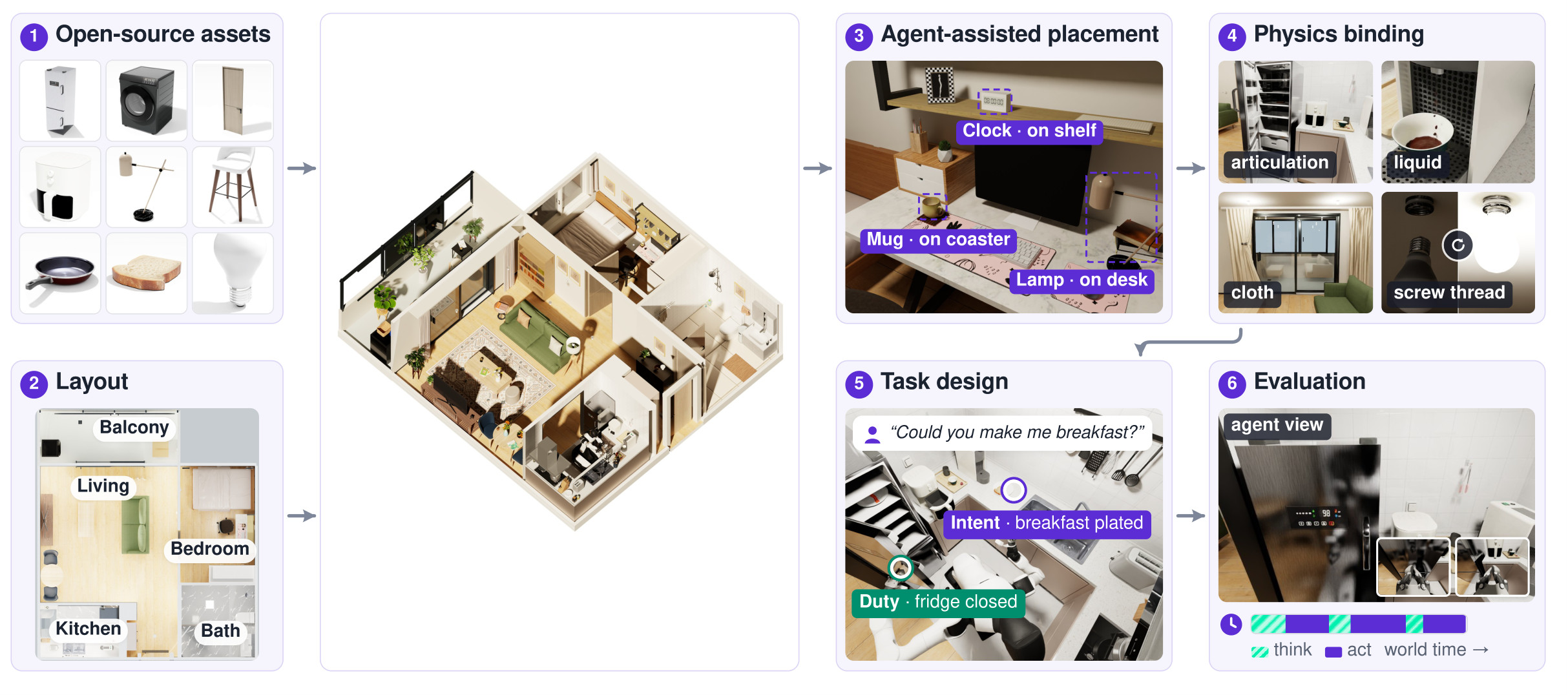
Stated as a person would, e.g. “Could you make me breakfast?” Judged on the request (Intent) and on unstated obligations (Duty).

02 / NO DEMOS

Experience acquired at test time

No in-domain demonstrations. The agent learns the scene through its own exploration.

03 / WORLD CLOCK

A world that keeps running

Thinking takes world time, as on a real robot. The judge watches the whole trajectory, even after the agent says it is done.

Building and using the household environment
Interactive homeNot loaded
A cutaway view of the furnished apartment scene
Room tour: a camera fly-through of the apartment, from day to night.
Laundry: carry the basket, load the washer, add detergent, start it.
Coffee: brew a cup with the capsule machine.
Breakfast: prepare a meal with the air fryer and toaster, while the world clock keeps running.

Findings in the household and open challenges

1 / 4
Finding 1

It attends to the object in hand and loses track of the rest of the home

Its own arm and the states it has changed seem to enter its decisions only when they block the next step. A final-state check would miss this, so the judge tracks the whole trajectory.

Finding 2

Without demonstrations, it does not work out how unfamiliar fixtures move or where its own body has to be

It plans for the gripper and handle, not its whole body, and repeats and adjusts the same motion. In Section 01, the demonstrations it distills in context show both, so this weakness does not appear there.

Finding 3

It bases decisions on observations that become outdated while it thinks

It rightly decides to turn off the burner once the egg sets, but thinking takes world time: the burner goes off about 90 s late and the egg chars.

World clock
Too late

The simulators of Section 01 wait for the model. This world does not, so the action arrives too late.

Open challenges

What a next-generation benchmark still has to solve

Measuring deployment rather than isolated tasks raises four open problems for the judge, the simulator and the evaluation budget.

01 / JUDGE

Evidence for the judge

Simulators model key physical facts heuristically; vision-language success detectors reach at most 60% balanced accuracy on contact-rich assembly.

02 / FIDELITY

Simulation fidelity

Modeling errors look like agent behavior; simulation has been shown to predict real-robot results only for short tabletop tasks.

03 / REAL TIME

Real-time evaluation

If the world keeps running, scores depend on latency, hardware and service load.

04 / COST

Evaluation cost

Hour-long deployments are expensive to repeat; even short robot trials are typically run too few times to separate policies reliably.

A clear leap in embodied intelligence —
but not its endpoint.

Strong harness design with in-context learning and a sufficient execution budget can push many isolated benchmarks close to saturation. The remaining challenges shift toward transfer across tasks, long-horizon reasoning, failure recovery, and real-world constraints on time, cost and safety. The next frontier is not simply to solve more isolated tasks, but to build embodied systems that operate reliably and efficiently under realistic deployment conditions.